

❓ FAQ & Troubleshooting
How can I send all my old emails from Gmail to Parsio?
The easiest way is to import them directly from your mailbox — see Import Existing Emails from Your Mailbox. Parsio connects to Outlook & Hotmail (one-click), or Gmail, iCloud, Yahoo and any IMAP server, and lets you pick exactly which emails to import.
If you’re using the Gmail web interface, you can forward multiple existing emails to Parsio at once.
Select all the emails you want to send.
Click the three dots menu.
Choose Forward as attachment.
This will forward the selected emails to your Parsio mailbox as .eml files.

What can I do with the JSON code generated after parsing a document?
Parsio extracts data in a structured JSON format, giving you full flexibility in how you use the results.
You can:
Export parsed data as Excel, CSV, or JSON (per document or in bulk)
Sync data in real time using the native Google Sheets integration
Send data to other tools using automation platforms such as Zapier, Make, or n8n
This allows you to automatically push parsed data into your CRM, database, accounting system, or any other application.
How can I fix “failed to parse” documents? (template-based parser)
If you already have a template and receive a slightly different email that fails to parse, most of the time you just need to create an additional template for that variation.
For more detailed guidance, check out our dedicated article with tips and troubleshooting steps.
Can I search for words in emails and trigger an alert?
Yes, there are two main options.
Option 1: Using an automation platform
Automation platforms like Zapier or Make provide filter modules.
You can search for specific keywords in the parsed data and trigger actions such as:
Sending an SMS
Posting a Slack notification
Sending an email alert

Option 2: Using the post-processing step
With the post-processing feature, you can write custom Python code to:
Check whether parsed data contains specific keywords
Trigger a webhook or other action when a condition is met
How can I fix incorrect dates when exporting data to Google Sheets?
In most cases, you simply need to update the column format in Google Sheets to Date, or Date time:

How can I extract a URL or image URL from my emails (template-based parser)?
There are two options.
Option 1: Use the URL field type
Select the link text and create a new field.
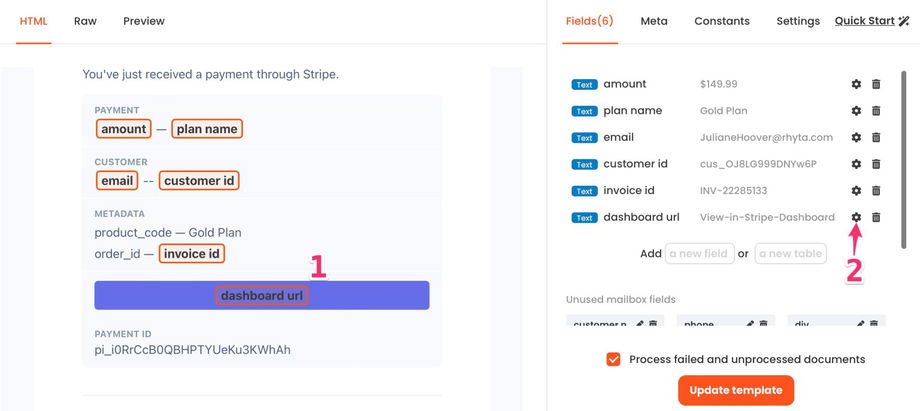
Change the field type to URL.
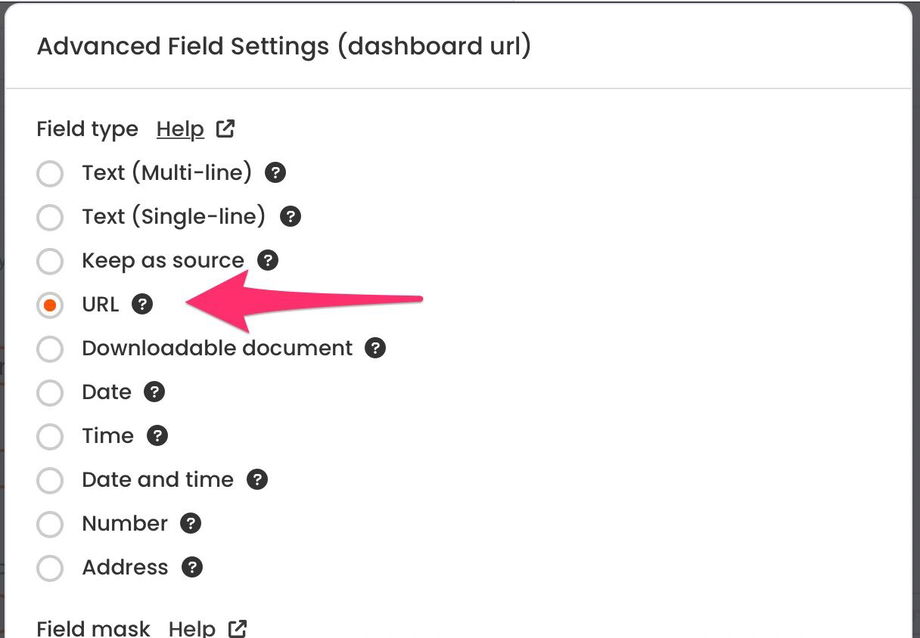
Parsio will attempt to extract the corresponding URL automatically.


Option 2: Use the Raw tab (template-based parser)
In the Raw tab, you can access the email’s HTML source.
Locate the URL or image source in the code and create a field from it.

Will data be deleted from Google Sheets if I delete a document in Parsio?
It depends on how you export your data.
Using an automation platform (Zapier, Make, Pabbly, etc.)
The data is copied to Google Sheets. Deleting documents in Parsio will not affect existing rows.Using the Google Sheets formula
The sheet displays live data from your mailbox. If a document is deleted (manually or due to retention rules), the corresponding row will also be removed.
See our article on how to export parsed data to Google Sheets for more details.
The wrong template was applied. How can I fix this (template-based parser)?
If multiple templates exist in the same mailbox, an email may match more than one.
To force Parsio to use a specific template, you can:
Add more fields. Templates with more fields have higher priority.
Make the template more restrictive. Use a Field Mask (for example, an Exact match) to limit when the template applies.

I signed up using Google. How can I create a password?
You can create a password using the Forgot password page.
Log out of your Parsio account.
Follow the link sent to your email.
After that, you can log in using your email and password or continue using Google Sign-In.
Didn't find what you are looking for? Don't hesitate to contact us anytime via live chat or email us at support@parsio.io.